2026.11 - Wednesday, 15 April 2026
10 March
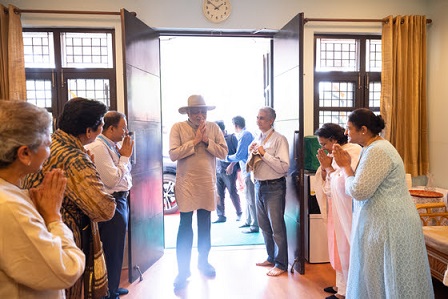
Early in the morning, Daaji departed from Satkhol, beginning his journey by car toward Haldwani. Upon arrival, he received a warm welcome from the abhyasis of Haldwani and nearby local centres. After conducting meditation, he had a brief breakfast before setting out again by car for Moradabad—a journey of about two and a half hours.
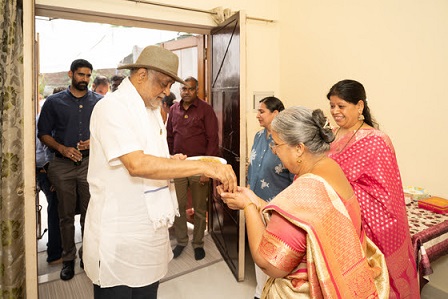
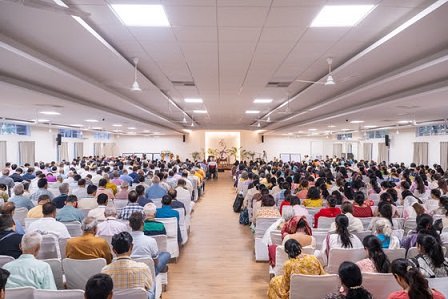
Daaji was to stay at a local abhyasi's residence in Moradabad. Upon arrival, he rested after the long journey, and after lunch, he took some additional rest. Early in the evening, he set out for the Moradabad Heartfulness Centre, where seekers—both new and seasoned—had gathered to meditate with Daaji. Among those present were many medical students and doctors, hence Daaji's talk focused on regenerative medicine, the frontiers of stem cells and genetics, and how the scientific approach of Heartfulness meditation contributes to these fields. Here are a few excerpts from his speech.
Many modulators play a role in our moment-to-moment life, influencing our cellular structure and, in turn, our genetic expression—what we call epigenetic influences. I would like to share an example from Dr. Bruce Lipton's research. He conducted a study over a period of time in a highly stressful environment, where expectant mothers lived under constant fear and uncertainty. Because of this, they remained in a heightened sympathetic state, and stress hormones were continuously released into their system. These hormones crossed the placental barrier and adversely affected the development of the fetus. As a result, the limbs tended to be overgrown, while the digestive system was compromised. The prefrontal cortex received less nourishment, resulting in reduced cognitive abilities, and in some cases, the back portion of the brain appeared more pronounced.
In contrast, in harmonious and stable environments, fetuses were found to develop well—mentally, emotionally, and physically—and thrive far better later in life. This is what we understand as epigenetic influence. External conditions can deeply affect not just individuals, but generations, since their cascading effects continue to the next generation. This shows how external conditions can deeply influence development even before birth.
I have introduced a conceptual term "endogenetics" to point toward how our inner climate—the mental disposition and calmness one feels after meditation—percolates in our day-to-day moments and daily activities. This leads to what we call a steady state of mind, despite the externally driven influences. It is what Lord Krishna calls sthitapragya [sthita - established, steady, firm, pragya - wisdom/higher knowledge/insight]. In such a state, methylation and phosphorylation levels are reduced, and there is enhancement in the activities of telomeres—all of which are measurable. You, being from the medical field, will really be able to appreciate the research that is done on the effect of meditation at multiple levels in genetic expression and cellular division as well.
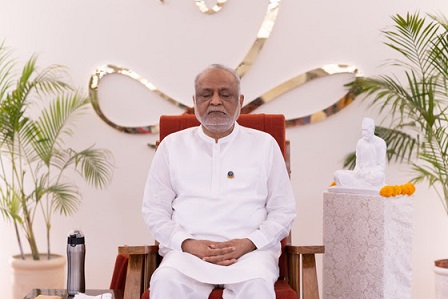
Heartfulness meditation is not an ordinary type of meditation. It is aided with what we call Yogic Transmission. And you will be able to appreciate the role of this transmission from the trainer to the recipient. It is like resonance; you click something and there is resonance, like in musical instruments or the tuning fork.
To truly understand meditation in depth, we must turn to its original Sanskrit term— dhyaan. Some people say, "Oh, dhyaan means to become peaceful, to become thoughtless, or to become relaxed." But these are not its true definitions; they are only results of having performed dhyaan. Dyaan when split becomes dhyee + yaan. Dhyee means pragya (wisdom); not any ordinary wisdom, but the ultimate wisdom. Yaan means vehicle/means/process. So, the vehicle which takes us to the ultimate wisdom is dhyaan (meditation).
You must have heard the use of this word in the Gayatri Mantra, invoking Mother Gayatri to bestow this ultimate wisdom. So, words like dhyaan are the keys or passwords given to us via mantras. But unfortunately we keep repeating such passwords without actually accessing the real dimensions they promise us. Let's see it this way: when anything is needed to be transported from one level to another, for example, an electron from the first orbit to the second orbit, it needs an energy input. In the same way, for consciousness to move from its present state to a higher level of pragya (ultimate wisdom), it requires an input of energy. This occurs through resonance, where the trainer is able to transmit and elevate our consciousness in a way that is both palpable and measurable.
Since you are all medicos, you can run experiments to see the difference in the effects of ordinary meditation on the heart, and the same meditation on the heart but with Yogic Transmission. You will be able to notice the changes on an EEG (electroencephalogram): the waves shift instantly. The moment Yogic Transmission occurs, brain waves begin to change—sometimes showing delta waves, with alpha and theta appearing initially; however, as meditation deepens, it gradually moves toward delta. Now, in general, we understand delta waves to occur when a person is in deep sleep and not otherwise. But when a person is in samadhi (deep meditation), and you observe these delta waves, you may conclude that he is asleep. However, he remains fully aware—if a bell rings, a phone sounds, or a conversation is taking place, he will later say that he heard it all. So, to me, samadhi is something like having delta waves with full awareness. As Lord Krishna also describes, this is a quality of a yogi—he appears to be asleep, yet is fully aware. Yoga scriptures refer to this as turiya—the fourth level of consciousness. While modern science recognizes only three states—waking, dreaming, and deep sleep—yoga scriptures speak of such lofty states and beyond.
There is also a fifth level of consciousness, experienced by advanced meditators, in which one remains inwardly centered while performing all day-to-day activities efficiently—calm and undisturbed by external influences; in other words, meditating with open eyes. This is called the turiyateet state. All these states are somehow projected, I would say, or related to gods and goddesses, so that people are moved to achieve the same. This is entirely scientific, and it is to our advantage to make use of such methods and benefit from them—at the very least to improve our health and consciousness.
Forget God for the moment. God will come when our consciousness is sufficiently refined, and we will then be able to understand that level of divine consciousness. For now, let us focus on what is humanly possible through yoga, and especially through meditation. Yoga is often understood merely as breathing exercises and asanas, which are beneficial for the physical body; but if one truly wishes to develop consciousness, there is no other way than meditation—and that too, when practiced with transmission.
So I hope you will adopt this in your day-to-day life. Practicing meditation once in a while is like jogging once in a decade—it will not help much. Often, and unfortunately, people postpone such things for later in life, and that is how we end up creating a generation that is spiritually weakened and inwardly impoverished. And this has deeper implications for society as well.
For example, nowadays marriages are often postponed into one's thirties. By then, one's cellular disposition, vibrations, and inner spiritual state are not deeply integrated at a microcellular level with one's consciousness. What can a person at a later age, say at seventy, even if spiritually advanced, transmit genetically to the next generation? It is unthinkable. Postponing spiritual life is, in a way, like committing a kind of spiritual suicide for society. If one begins spiritual practice early—even before marriage—then there is a greater possibility of transmitting those refined vibrations to the next generation.
Daaji's inspiring talk left the audience with much to contemplate, bringing another day of his visit to a peaceful close. With his onward journey to Gurugram scheduled for the next morning, Daaji left the venue and retired for the evening.
11 March
Daaji left for Gurugram amidst heartfelt goodbyes from the local abhyasis. After a drive of nearly four hours, he arrived and took some rest after the long journey. He was scheduled to conduct meditation at the Gurugram ashram, after which he interacted with the abhyasis in a question-and-answer session. Here are some excerpts from that interaction.
Q: How can seekers preserve a childlike simplicity and purity of heart amidst daily responsibilities and life's complexities?
Daaji: That is why we meditate. That's all I have to say.
Q: While meditation helps us experience inner peace, how can seekers ensure that this inner transformation reflects in their behavior, and relationships with others?
Daaji: The answer to this is also quite simple. Please revisit the message The Divided Heart (released on 2 February 2026 during the second batch of the Basant celebrations). I was prompted to write this message after a gentleman shared his personal struggle with me. He was in his fifties, married with children, and despite having practiced meditation for many years, found himself struggling with strong sensual tendencies and drawn repeatedly into multiple relationships. You are divided between two desires: you want "Ram" [the higher spiritual ideal], but at the same time you also want "Romance" [desirous indulgences]—how will it be possible? If you seek romance, it must be honored within your committed relationship, rather than being dispersed across multiple attachments.
With a divided heart, you are divided into many channels. So, forget about God, forget about inner peace—nothing is gained from a divided heart. For example, take a labourer who earns daily wages of 500 rupees. On his way home, he will spend 200 on whiskey, then spend some on food, and finally totter home, drunk. What will such a man give to his children? When will he build his own home if he keeps wasting his money? This is just an example. But some people spend 50 lakhs a day and it doesn't even make a dent in their wealth. They say "we have everything," but the spiritual palace, the spiritual foundation they wish to build won't be possible. So, if you have the awareness that you must become something, achieve something in spirituality, then you will have to lose something—you can't have your cake and eat it too.
The condition you receive after meditation is like the wages earned each day. If, like that careless labourer, you lose it mindlessly here and there, then what will you take with yourself when you die? Will you go empty-handed? Instead, you will be full, full of only grossness. Every parent wishes that their children do better than them, excel beyond them—this is natural. Even God wishes the same for us. But people lack the understanding of how to go beyond God—beyond their present idea of God.
Let me ask you a question: Do you feel ashamed before doing something wrong, during the act, or afterwards? Observe these three stages carefully. If you stop yourself just while thinking of doing something wrong, then you are smart. If you stop yourself during the act, then you are less smart. And if you do not even realize that you have done something wrong after the act, then you are the most foolish—and for such a person, there is no solution. Meditation for such people will be poison for them because during meditation, their attention is focused on thinking about doing those wrong actions.
As Babuji wisely pointed out, Yogic Transmission, or pranahuti, can be used, as well as misused [by the receiver]. For example, a thief who meditates will become a better thief, because he will meditate on thieving and robbery. As we know, in a court of law, criminals are accused of "premeditated" murder or fraud.
So the real question is: what do you want? If you wish to progress, then whatever condition you receive during meditation, safeguard it—you must value what you have received. If you do not value it, it will disintegrate and disperse, but if you do, it will accumulate, and then you will begin to experience the real joy in it, the real beauty of it.
Q: Sometimes we do not consciously feel transmission during meditation. Does the inner work still continue?
Daaji: Transmission does not happen all the time, and we need not feel it all the time. This is something we must remember. I repeat this for emphasis: transmission is not always flowing into our heart.

For example, some of you may be familiar with sustained-release tablets. They release the medication gradually into the bloodstream over the next 12 to 24 hours, but you have to take it only once. Babuji's work is also like this—precise and sustained over a period of time. However, it depends on the situation: He may transmit a microdose of transmission, which can last for days. Sometimes, just a single dose of transmission works for the entire period of a lifetime.
So, we have to hold on to that. We do not know when we will receive, or what we will receive. What is required of us, 24/7, is alertness—how alert we are: first, in receiving; second, in identifying what we have received; and third, in retaining it. We must be alert enough not to let it get destroyed. This should be enough for us. I would like you all to meditate tomorrow morning at seven, wherever you are. You don't have to be present here in the Ashram—you can meditate wherever you are. Thank you.
Watch the session
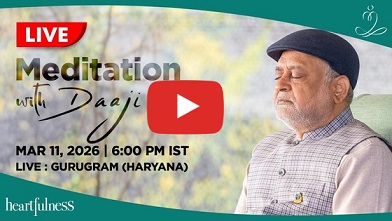
Daaji's words, simple yet profound, left the gathering in a quiet, reflective stillness—each sentence carrying layers of meaning to be absorbed over time. Daaji retired for the day, as he was scheduled to leave early the next morning for his return journey to Kanha Shanti Vanam, Hyderabad.
Stay tuned for more of Daaji's travels in Central India.
For more information regarding Daaji's day-to-day life, visit www.daaji.org/glimpses