

 Web Content Display
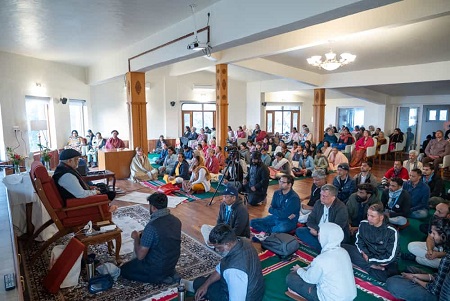
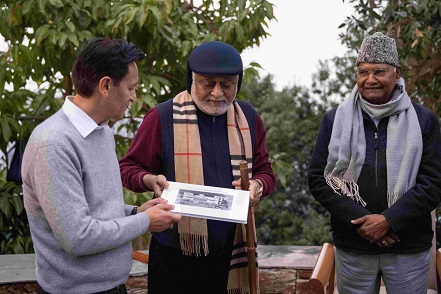
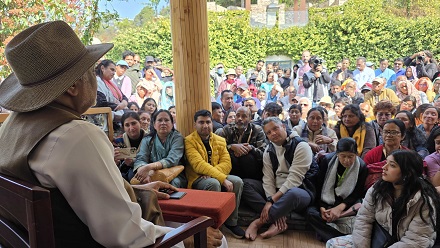
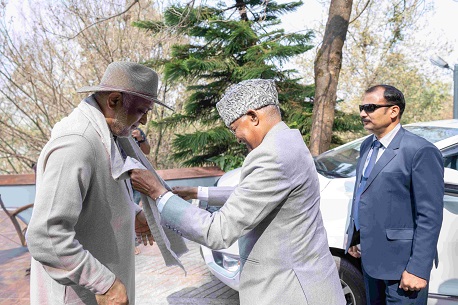
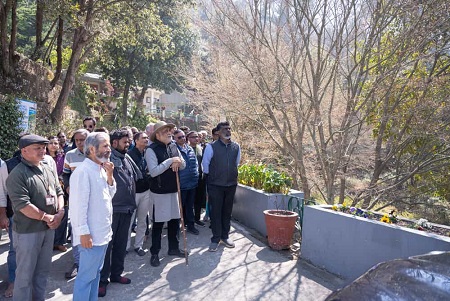
 Daaji's Visit to Satkhol, Uttarakhand Part 12026.6 - Tuesday, 17 March 2026 5 MarchIn the morning, after breakfast, Revered Daaji left Naukuchiatal for Satkhol. He arrived at 10.30 a.m. and soon thereafter, conducted satsangh in the main meditation hall at the Heartfulness Himalayan Ashram. The evening satsangh was also conducted by Daaji at 6 p.m. An announcement was then made that satsangh in the days to come at the Satkhol Ashram would be conducted at 6:30 a.m., 11:00 a.m., and 5:00 p.m. 6 MarchGroup meditation was conducted by Daaji early in the morning at 6:30 a.m. after which Shri Bhupal Gangwar of Kichha, Uttarakhand, was made a preceptor and granted permission to work as a trainer. Then Daaji went for a walk around the entire ashram, accompanied by the Ashram manager. Along the way, many abhyasis quietly stood aside to greet him, mindful not to disturb his walk or its purpose. After completing the walk, Daaji was exhausted and went to rest. The arrival of the former President of India, Shri Ram Nath Kovind, marked the day, as he joined the abhyasis. At 10:30 a.m., Kovindji arrived at the Pearl hotel in Satkhol and soon thereafter Daaji conducted the 11 a.m. satsangh. After having lunch with Kovindji, Daaji took a short rest. After conducting the evening satsangh at 5 p.m., Daaji engaged in conversation with Shri Deepak Rawat, Commissioner of Kumaon, and Kovindji, regarding the natural resources and development challenges of the Kumaon region in Uttarakhand. Several ideas that Daaji had envisioned for a long time came to the forefront. They discussed the potential of aromatic and medicinal plants such as geranium, which are in high demand globally. Daaji suggested that, given the region’s climate advantage, such cultivation in village clusters with proper training could create sustainable livelihoods for rural communities. Another issue discussed was the accumulation of pine needles across the forests. These needles acidify the soil, prevent rainwater from seeping into the ground, and increase the risk of forest fires. Daaji suggested that the systematic collection of these needles and their conversion into biofuel briquettes or charcoal could become a village-based cottage industry supplying nearby industries, though scaling such efforts would require greater institutional support. The discussion also touched upon traditional practices and the history of forestry in the region. Deodar trees are traditionally associated with temples and sacred groves, where they were planted to prevent soil erosion. It was also noted that deodar trees propagate better naturally, while plantation survival rates are often low unless the saplings are raised carefully in nurseries. Daaji mentioned that there were 1600+ deodar trees planted in and around the Satkhol Ashram. The conversation also addressed the decline of farming in the hills. Crop damage caused by wild animals such as monkeys and wild boars has discouraged many farmers, leaving large tracts of land uncultivated. Some farmers have turned to crops like kiwi, which animals avoid, while others sell their land for tourism development or migrate to urban areas. Government homestay schemes were also discussed, along with concerns about their misuse and the sustainability of increasing construction in the region. Throughout the discussion, the idea of a cluster-based approach emerged as important for scaling rural initiatives—whether in aromatic crops, forest resource utilization, or small village industries. Many of the ideas reflected Daaji’s long-standing vision of using the region’s natural wealth to create sustainable livelihoods while maintaining the ecological balance of the Kumaon hills. After the departure of Shri Deepak Rawat, Daaji and Kovindji had their dinner together, and then Daaji retired for the day. 7 MarchThe day dawned bright and clear, promising more valuable insights through conversations with Revered Daaji. Indeed, it turned out to be the busiest day so far of Daaji’s travels. He conducted the group meditation at 6:30 a.m., after which he retired to his room in the cottage, working. He conducted group satsangh again at 11 a.m. After the session, Kovindji met with Daaji in his office and presented Daaji with a copy of the book he has authored. He shared with Daaji how he was encouraged to write his memoirs by many, given his rich background and history, and how his message would inspire Indians, especially the youth. “There is also a chapter about the Shri Ram Chandra Mission in it. The memoirs are due to be released by Hon’ble Prime Minister Shri Narendra Modi on 18 March 2026,” Kovindji remarked. After his lunch, Daaji was informed that many abhyasis from nearby places such as Pithoragarh, Almora, Nainital, to name a few, were waiting outside. Daaji interacted with them for almost an hour, sharing several pearls of wisdom. Here are some snippets of this conversation. Q: Master, I am in some sort of fear. I am not able to open up myself, or even go to places to meditate. I sit at home, but I don’t feel like going to the meditation center. Daaji: Today at the 5 p.m. satsangh, sit in the front row. Q: Master, I have a procrastination issue. I keep delaying things. How do I fix this? Daaji: Use the Cleaning method to fix it. Babuji used to say, “50% of your problem is solved once you know the problem.” Now you have diagnosed the problem. The solution is to submit to the Master how to get rid of it through Cleaning. In the evening when you sit to do your Cleaning, make a prayerful resolution that my procrastinating nature, or any fear I have, is going away from me. Q: Daaji, sometimes our external environment disturbs our inner one. How do we control this? Daaji: Well, it’s very easy. I’ll give you an example. This was around the time when I was studying in pharmacy college. On 30 April 1978, Babuji gave a message in Bangalore: “The external temperature keeps changing from hot to cold and cold to hot. But in an air-conditioned room we can maintain the same temperature throughout.” Lord Krisha mentions it as sthitapragya, the steady state of your pragya or your higher awareness. This sthitapragya comes from meditation, and constant remembrance protects and preserves it. If we miss this constant remembrance, we remain vulnerable. So “air-condition” your heart, so that it is not influenced by external circumstances. Keep the goal in mind: contemplate on whether what you are doing will benefit you in reaching your goal, or not. If it does, do it, if it doesn’t, let it go. One needs guts to let it go. Therefore, they say that the path of spirituality is not for cowards. And if we have the Master with us, why worry at all? Be confident. Live life joyfully. Whatever you do, do it perfectly, not half-heartedly; put your whole heart into it, whatever you do. Q: When I meditate, the only wish at that time is to merge…everything else [inaudible] Daaji: But that is the wrong perception. At the time of meditation, just meditate as prescribed. Don’t entertain such thoughts. Whatever happens, let it happen. Q: Emotions are so stressful…so painful…[inaudible]...deattachment… Daaji: What is it you want to get rid of? What did Babuji do? He too would worry for his children, he had concern for them. Do you think this was an attachment? That is duty—it's a loving attachment. Tell me, which things exist in this world that don’t have God in them? So if you have to “detach” yourself from it, you are detaching from God Himself, isn’t it? Even Raja Janaka, 7000 years ago, posed the same questions to Ashtavakra: How to develop vairagya or detachment? How to gain the ultimate knowledge? How to achieve liberation? He said, vishayaan vishavat tyaja, meaning treat attachment to sense objects with the same caution as poison. [Sense objects themselves are not the problem, but attachment to them—like poison that appears harmless yet harms from within—makes the mind restless and dependent, eventually leading to fear and suffering.] Q: [inaudible]...AI, using it…[inaudible] Daaji: Well, ask yourself, “Is it good for me, for my evolution?” For example, if some of the messages Babuji wrote about paradoxes and nature’s dynamos go right over your head—like a bouncer bowled in cricket, then enter the text into ChatGPT, which will analyze it and examine it from many angles and perspectives that you may not even have thought of. So, AI can be useful if you wish to explore deep and serious topics. You say many people will lose their jobs because of AI, why are you worried about them? Like the American attack on Iran that used Claude, also an AI tool: good or bad? It depends on who is using it. You see, the very first quality to develop when one meditates is discernment, or Viveka. Babuji said that as one progress on the spiritual path, their power of discernment increases—you will be able to figure out what is right or wrong for you. After that, it’s up to you. Q: I loved my husband…. [inaudible]...attachment [crying]…I can’t meditate…what should I do at that time? Daaji: Do nothing. It’s okay to think of him. Have some water and then sit. I still cry—quietly, in my bed—whenever I think of my father, but that doesn’t stop me from meditating. It is a misconception that attachments are a sin. There will always be pain in separation. When I think of my mother and cry, it’s not my love for her that makes me cry. Love doesn’t make one cry. It is because of what I should have done for her and did not do when she was alive that makes me cry. Otherwise, real love doesn’t make you cry or sad; it elevates you. Like when we remember Babuji: do we get disturbed in meditation when we remember him? Q: In spite of doing meditation for so long, we still get ensnared and involved in “wrong” things? Why? Daaji: It is because you don’t have control over it. Q: Then how do we overcome it? Daaji: The Master cannot help you there. As long as samskaras are there, their pull will exist. Even after they are removed, there is something that still bothers us, that creates resistance—our tendencies. Like the riverbed which has dried up, the water (the samskaras) has evaporated, but the riverbed (the tendencies) remains. If it rains again, the river will start flowing again. So, under certain circumstances, or the effect of a certain external environment, you are pushed and pulled in all directions. Babuji’s solution was to develop the condition of “living dead.” He said, bulldoze your “riverbed,” then the waters will not gather again. Q: I am a lawyer and involved in all sorts of cases. I can’t maintain my condition throughout the day, so much keeps happening. Even after evening cleaning, it all seems to come back by next morning. Daaji: Toss it! Play a game with it! I am serious: if you treat it like a game, it will not stick to you. Actors do method acting. They treat their role as real, become the character, and act as if it were their real life. Here, do just the opposite. When you get involved in your case, act it out as if it were a play. Don’t get sucked into it. Simply perform your role as a duty. Do the Cleaning regularly. Once, the Chief Minister came to Kanha and was impressed by the quality of our ponds. We were given a similar project in the city nearby. This pond was surrounded by high-rise buildings, all of them dumping their waste water into the pond. So I told him that we will clean it, but within a month it will become dirty again. What needs to be done is to stop the inflow of pollutants, or else we will be cleaning the pond forever. So you see, you have to find that way to stop the inflow. Submit your case to the Lord and pray for His help and guidance. And He will help you. We all have to go through this. Q: During individual sittings and satsanghs, I get so restless that I can't meditate or keep my eyes closed anymore: I simply don’t feel like sitting there anymore. Daaji: Compare sitting in meditation to sitting on a flight. If the plane experiences turbulence, will you jump out of the plane, complaining about the turbulence? So why open your eyes during meditation? Continue with the “turbulence;” it will quieten after a while. Sometimes, when I give a sitting, my work is over in five minutes, but I have to sit there for a while or people will wonder and question. So, like you, I just sit there also with eyes closed, waiting for it to be over! [laughter] Daaji listened to each question with deep patience and empathy; often, it seemed that half the answer was already contained in his attentive listening. Drawing from his own journey on the path, he reassured practitioners and offered practical ways to face their challenges. At the same time, he lightened the atmosphere with gentle humour, punctuating even the most grave questions with warmth and ease. Stay tuned for Part 2 of Daaji’s travels in Satkhol, Uttarakhand. For more information regarding Daaji’s day-to-day life, visit www.daaji.org/glimpses |