

 Web Content Display
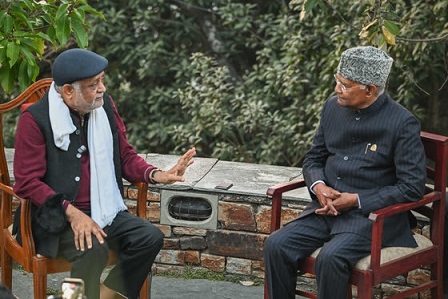
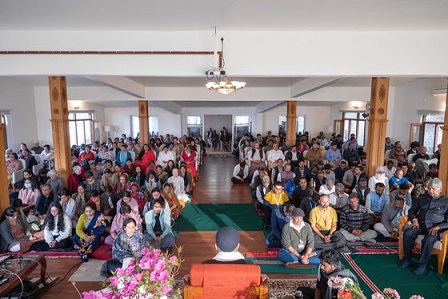
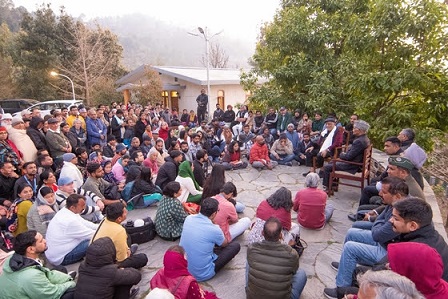
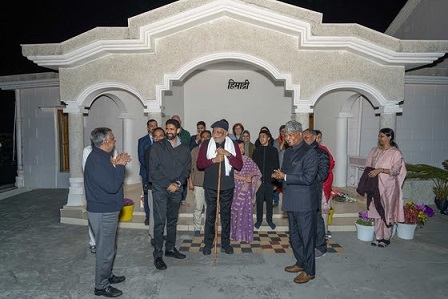
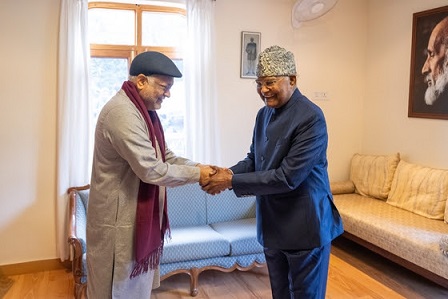
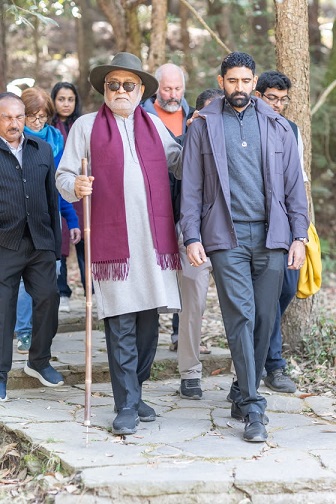
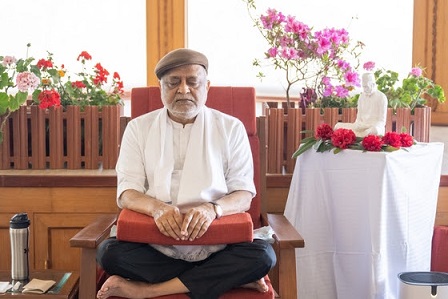
 Daaji's Visit to Satkhol, Uttarakhand Part 22026.8 - Wednesday, 25 March 2026 7 MarchDaaji conducted satsangh in the evening at 5 p.m., after which a lively conversation ensued with the abhyasis present there. The former President of India, Shri Ram Nath Kovindji, was also present there. The topic began with Kovindji mentioning the occurrence of coughing during sittings. Daaji remarked that often people begin to cough as soon as the sitting starts, and as soon as it ends, they calm down. Although, both happen for different reasons. They also calm down because of the actual meditation, he reasoned. Then the topic shifted to something entirely different. Daaji: I have made an observation regarding the issue of people having too many thoughts during meditation. One reason is that they have never even once tried to regulate their minds in the course of their life—not even for 5 minutes in 24 hours have they ever consciously tried to regulate their mind. And then they try to regulate it for half an hour [in meditation]. It is like trying to train an undisciplined child—it has always been allowed to do as it pleases, and then when guests arrive for a visit, the child is asked to behave itself. Will it work? The second reason for this rush of thoughts that bother us during the sittings is because of [remorse or regret due to] tasks which we have ignored or left incomplete; things we should have said, but didn’t, and things we ought to have done, but didn’t. During meditation, thoughts related to such tasks will keep surfacing. Sometimes during meditation, random thoughts arise, which make us wonder whose these thoughts are, mine or someone else’s, where on earth they are coming from, and why they are coming, because we are not able to connect with them. When you open your eyes after meditation, you will not be able to recollect such thoughts that disturbed you during meditation— these are [impressions] from our past lives. Only very rarely will you be able to recollect them. But those thoughts that arise from incomplete or ignored tasks from this [present] lifetime, you will be able to recollect after meditation. This is just in general. Whatever the case may be, it is good to know that the sitting in which plenty of thoughts come is the best sitting, because this indicates that a lot of grossness from within is being cleaned out. Whenever you do something, an emotional impression is left on you, and it remains buried in your subconscious. During meditation, when it is getting cleaned out, it re-creates the same emotional state that existed when it was formed. So, either you gain that same condition or you recollect that particular thought, but without any connection to it. “When I was in college, my friends and I would often go to the cinema theatres and watch 3 movie shows–back-to-back. Per chance, when I took an individual sitting from my preceptor thereafter, it was like the movies began to replay in my mind, all over again. Then onwards, I developed such a condition that even while the movie was playing in the cinema hall, it used to get so filled up with transmission, my eyes would blur and I could not see anything on the screen. So I used to walk out halfway through the show. My friends soon stopped inviting me [laughter]. So, such things like movies…[pause]...it’s okay to watch them as time pass, but don’t get too absorbed in them. Nonetheless, we still collect a lot of baggage from them, some impressions get loaded onto our hearts, and sometimes, some impressions get reinforced because of movies. Q: What about watching the news? Daaji: Same thing. One of Babuji’s spiritual associates, Shri Madan Mohanji, used to wake up each morning and religiously read the newspaper while having his tea. He would read each line and even underline the text with a pencil. After that, he would shout to his wife, “look what happened here,” “today this happened,” and so on. This went on until Lalaji intercommunicated and ordered him to stop his habit. Q: Daaji, you seem to be working constantly without any breaks—you are not taking any ‘chill’ time. Daaji: [chuckling] Meditation is my “chill” time! Meditation is not work for me, it’s joy. When you work with joy, it can never trouble you. If you enjoy your work, work will never limit you—it becomes entertainment for you. Q: When I meditate, my attention is drawn towards my heartbeat and its rate increases to the extent that I feel my heart will burst. What should I do? Daaji: We don’t meditate on the heartbeat. Remove yourself from this thought.When this happens, try one of these things—open your eyes, if it doesn’t work, walk around a bit, or else drink some water. Water has the ability to change the condition. If you notice, water is immediately given to people if they have received some shocking news, or to children when they cry. Babuji told me about this once after a satsangh in his house in Shahjahanpur. It was a particularly hot day, and as soon as the sitting ended, I immediately stood up and turned on the ceiling fan, thinking I was doing a good deed for all. Babuji noticed this and immediately told me to stop the fan. He then explained that one must not drink water immediately, and do not turn the fan on or off immediately—if it's on, let it be on, if it's off, let it be off. Basically, what it means is to not change the external circumstances immediately after satsangh, because then you will go outwards. But sometimes people take this too rigidly—I must have once mentioned this in Kanha in 2012, and they stopped serving water in the meditation hall altogether. [laughter] Q: When it comes to karma, what should I believe in: my destiny that makes me do it, or the “karm” (work) that I do? Daaji: Just do your work, wherever it is coming from. Destiny will do its work, it is not in our control. And of what use will it be even if you come to know that it is destiny doing its work? If you fail in your exam, what will you think—was it my handiwork or was it my destiny? You failed, and that’s that. Q: What is the concept of time? What is time? Daaji: Time is our illusion: it does not exist. Because of events happening in our life, we relate to time—the past, present, and future. To me, time doesn’t exist: it is always “now.” Even “now” is not possible, before you finish “now,” it's gone. It is like a continuous flow of a river. Read the Bhagavad Gita, where Lord Krishna says in chapter 11, verse 32, “Aham kalosmi” (I am time.) And when you understand this, how can you waste time—time being God. So, always make the best use of the time that we have. To function in this world, we have to work with time, but in reality it does not exist. Neither can you go back in time, nor can you fast forward into the future. In a sense, time is relative—in the company of an unpleasant person, a minute seems like an eternity, whereas, in the company of loved ones, an eternity seems like a minute! So it is these perceptions we carry, but we confuse real perceptions with illusions, and become confused. Then Daaji left for his residence Himadri, where once again a conversation ensued with those present there. During the conversation, Kovindji commented on the increasing presence of women in the civil services, mentioning that the Union Public Service Commission has in recent times selected several women candidates for the Indian Administrative Service, including young women who are visually impaired and are now serving as district collectors. Daaji responded with surprise and appreciation, acknowledging this positive shift and the opportunities now being extended to those who were previously overlooked. Drawing from his own experience, Daaji shared that when he joined pharmacy in 1974, there were very few women in the field—only two in the previous year, and none before that. In his own class, there were about seven girls, whereas today, he observed, nearly 80% of pharmacy students are women, reflecting a significant transformation over time. A gentle silence followed, broken only by the birdsong in the background. After a few minutes, some abhyasis approached Daaji with questions. Abhyasi: I desperately wanted to be released from my emotional pain, and I am so relieved now that I met you. I feel light now; it’s all gone. Just one glance from the Master made it all go away. Daaji: They say “one glance,” but it is not that. Even that one glance is not needed. Abhyasi: No, it is needed. Daaji: As abhyasis, of course, we like to make eye contact with the Master. But for His work to happen, even eye contact is not needed. Our eyes [attention] should be on the Master, and that is enough. After this, Daaji had dinner and, being extremely tired, retired to his room for some much-needed rest. 8 MarchAfter the morning satsangh at the ashram, Daaji met Shri Ram Nath Kovindji before his departure. The farewell was warm and cordial. As a gesture of remembrance, Daaji presented him with a souvenir from the 153rd birth anniversary celebrations of Lalaji Maharaj held at Shahjahanpur, along with the commemorative coin released during the bhandara. Later, Daaji spent some time at his residence, Himadri, speaking with a small group of abhyasis in the soft morning sunshine. Also present were Daaji’s friends from the US, Shri Atul Shah and his wife, Smt Amita Shah, who had been Daaji’s junior in pharmacy college in Ahmedabad. The peaceful Himalayan air made for an unhurried and relaxed exchange. During the conversation, Daaji mentioned that October and November are among the best months to visit Satkhol, when the weather is clear and the beauty of the mountains reveals itself fully. Shri Atul Shah remarked that while Kanha Shanti Vanam carries its own distinctive charm, the Satkhol Ashram possesses an atmosphere entirely its own, equally powerful and uplifting. Responding to this, Daaji observed that every ashram of the Mission has its own micro-spiritual environment and character, each carrying a unique flavour. The conversation then turned to the Heartfulness Academy of Research and Innovation (HARI), a project close to Daaji’s heart. He spoke about the vision of developing the university as a place where technology, humanities, philosophy, and other disciplines would coexist and enrich one another. In particular, he expressed hope that the agriculture division, which is already taking shape, would one day gain recognition at the global level. Reflecting on India’s natural wealth, Daaji noted that few countries possess the extraordinary biodiversity that India enjoys. Within one nation, one can experience vastly different ecological zones, ranging from high-altitude terrains to humid tropical belts, offering immense potential for agricultural research and innovation. Shri Atul Shah mentioned that the University of Georgia has a very strong agriculture department and suggested that it might be worthwhile to explore possible collaborations. Daaji shared that several global partnerships are already underway, and that one university in the Netherlands and one in Israel, have recently responded positively to the initiative. Daaji also spoke about the potential for India to develop the world’s finest seaweed nurseries, pointing out that the Indian coastline, which is one of the largest in the world, contains nutrient-rich waters that are well suited for cultivating seaweed. Among these, he reasoned, the Lakshadweep Islands hold especially promising conditions. After lunch, Daaji sat outside his cottage with the abhyasis and conducted a brief meditation session for about ten minutes. Though the meditation was short, its effect was so peaceful that no one felt like speaking. It was one of those moments when much is conveyed in silence. The rest of the day unfolded with ease, alternating between conducting satsanghs, light work, and rest. Stay tuned for Part 3 of Daaji’s visit to Satkhol, Uttarakhand. For more information regarding Daaji’s day-to-day life, visit www.daaji.org/glimpses |