2026.9 - Wednesday, 1 April 2026
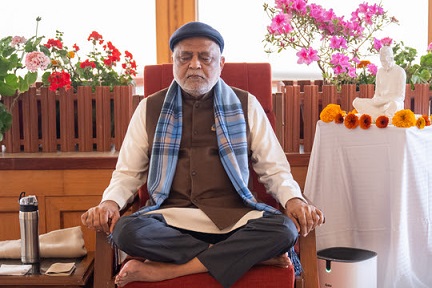
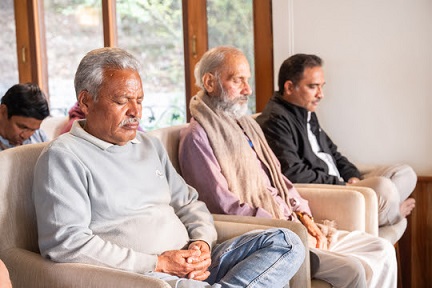
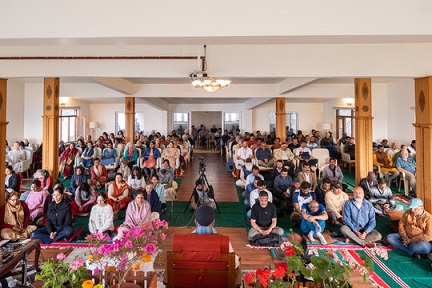
Daaji conducted the morning satsangh at 6.30 a.m. That afternoon, lunch was organised at Daaji’s residence Himadri, for all the abhyasis present in the Satkhol Ashram. After lunch, he spent some time with them. Against the breathtaking backdrop of the Greater Himalayas, the little gathering sat quietly. Daaji closed his eyes and seemed absorbed in spiritual work. Many found their own eyes closing automatically. This peaceful exchange continued in deep silence. Then, he posed a question to all: “When we sat down just now, how was it different from meditation?”
Some abhyasis shared their experience, and Daaji listened attentively. After some light conversation, he shed light on the aspect of ego in relationships.
Daaji: Most love affairs are sweet in the beginning and bitter in the end. Why? Because love demands dissolution into each other, but ego comes in the way, and then people pull back somehow in order to protect themselves, saying, “Oh, I am getting rushed into this relationship.” That’s when it starts to fall apart, even if they maybe stay together. I heard of a new term that identifies this: bedroom divorce. They live in separate rooms in the same house.
Abyasi: I have heard of one such case where children are involved.
Daaji: Sadly, we cannot do anything about such parents, but Nature will deliver justice. That’s why there is an increasing unfolding of samskaras, which is getting worse and worse.
Abhasyi: People are afraid to love after a failed relationship.
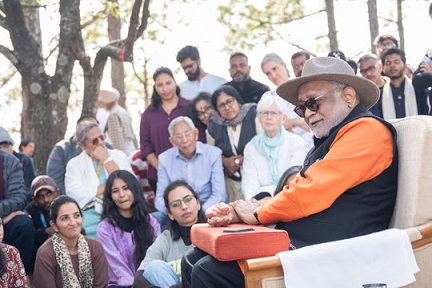
Daaji: Whom do you think, are they punishing then? So, they fail at one relationship, maybe two, or even three, and then their hearts close. That will only punish them, not their partner, isn’t it? A closed heart is like a river that has stopped flowing. It stagnates and starts to stink. They should have the sentiment, “You may not love me, but I love all.” This holds true for everybody.
One abhyasi shared her experience of reading the seven messages published during the 153rd birth anniversary celebrations of Lalaji Maharaj. In response, Daaji said, “It is like how Nature plans propagation: the seeds of a tree fall automatically—nobody teaches the tree how to multiply—and then the rain falls. It falls on everything, including stone and soil. Spiritual work also happens similarly—in those who are ready, you will see immediate results; for those who are partially ready, the work becomes available when they are fully ready.”
Abhyasi: It’s wonderful to read the…[inaudible] in Urdu. I feel something, but I don’t understand all of it, but I like to read it.
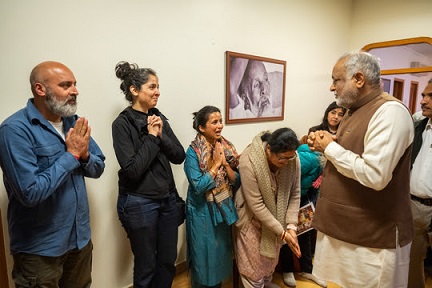
Daaji: It’s like consuming without digesting—like priests who chant mantras without knowing their real meaning. So, when you do things without understanding, it will create problems, because you have the false satisfaction of having done something. “Did you meditate?” “Yes, I did.” “What did you gain?” “I don’t know, Master.” So, we have to be receptive and sensitive—sensitive to every input, every impulse that comes to you, both good and bad. And that’s how we evolve with consciousness. The more you have the ability to perceive, the more receptive you are, and the faster you evolve.
But there is a drawback. Suppose you perceive something—that your father has a headache—but at that point you remember how he had slapped you sometime in your childhood, you might think derisively, “Let him have a headache now, I won’t do anything, let alone bring him a pill.” So you see, you may have become perceptive—to his problem—but you let your thoughts and actions go on the wrong track, colored by your past, and that will destroy you. Then your consciousness, though you are perceptive, will go backward.
Abhyasi: How to develop love for someone?
Daaji: Start with your family first.
Abhyasi: I already love…
Daaji: Love them more.
Abhyasi: I meant how to love someone we don’t even know? How to love all?
Daaji: Why all? Just target one first. Target the Master.
Abhyasi: I feel so much for the Master, but I don’t know how to express it…
Daaji: There is a beautiful qawwali by Nusrat Fateh Ali Khan, Likh Diya Apne Dar Pe Kisi Ne which says, Pyaar agar ho bhi jaae kisi ko, uska izhar karna mana hai (Even if one does fall in love, the declaration of it is forbidden).
Daaji then retired to his room to take some rest.
In the evening after satsangh, Daaji joined the media team for a recording session for a medical conference that was scheduled for 15 March. Later at night, after dinner, in the quiet of the Himalayan night, Daaji sat outside his cottage with the abhyasis present there and engaged in a lively conversation with them. He threw light on how longing creates a world of difference in our approach by sharing his own experience.
Daaji: An intense longing is required for the God-realization, for the next meditation, for the next remembrance. Constant remembrance is not the solution for everything. We tend to remember our enemies, our boyfriends or girlfriends far more intensely. But in remembering your Master with a lot of reverence, respect, and devotion, there is a difference. It depends on how you are connecting yourself. Whenever you think that your meditation was not satisfactory to your liking, take a sitting. There was a time when I used to take a sitting almost every day!
Q: Does one naturally feel like taking a sitting every day? Did you feel that way every day?
Daaji: I did…One has to have a certain level of “madness” for it. The path of spirituality is for the ones who have a ‘“madness” for it. If you think a hundred times before taking a step, you will not progress. There is a beautiful ghazal by Jagjit Singh, Log Har Mod Pe which says, Why do people pause and steady themselves at every turn, every bend? If they are so afraid, then why do they step out of their homes at all? Now that we have set upon this [spiritual] journey, what is there to think?
In my college days, my preceptor told me, “Okay, so do you love Babuji?” I nodded yes. “Then you must remember this song Pyaar Kiya To Darna Kya (I have loved, then why should I fear) from the movie Mughal-e-Azam.” And surely, this song became a bhajan (devotional song) to me! So, one has to have that kind of craze, intensity, that burning passion bordering on “madness” for spirituality, come what may. You create the madness, the rest He will take care of. Guaranteed.
Q: How to distinguish between “I” and the “Self” and how to recognize it?
Daaji: Let’s consider the word self with a lowercase s and uppercase S just for differentiation purposes. We call the higher Self God's essence. So, for example, when Babuji says “I,” versus an ordinary person saying “I,” there is a big difference. Babuji is saying it from that higher Self, the ordinary person is saying it from the lower self.
The lower self is one who is intertwined in the web of this world—in the complex web of likes and dislikes—that is the lower “I”. The higher “I” is beyond all that. Both are there in the same person. For example, when I get angry, that I-ness that I have, gets lower; it goes to the lowest level. When I am meditating and touching the planes of divine consciousness, my awareness is lifted up, and now I am in resonance with the higher Self. When I am in resonance with the higher Self, both are the same—I and Self become the same. But because of my emotion, when I plummet to the lowest, then there is separation between I and that higher Self. That’s why constant remembrance helps us to stay with that. Babuji once told me (about remembrance), though I bit my tongue immediately upon asking him the question. Why did I ask him at all? Because this idea of progress was not there in my mind at all, but my preceptor had advised me to ask him questions, and so I did. Then every time I asked a question, I regretted it. Why did I disturb his silence? One of the questions I posed was how to progress fast? He replied in two crisp words, “Constant remembrance.” Then I asked, how to (do constant remembrance)? He replied, “Connect yourself. Do you understand?” I said, “A little bit.”

He continued, “Every time you change your task, connect yourself.” And there was silence again. And I did not dare to disturb him again.
You can see when the Master is absorbed or doing some work, either with open or closed eyes. We should be sensitive enough when to ask, and especially when not to ask. It’s best not to ask and keep quiet, because all the answers—it’s not that you don’t know—you know them too well. You just don’t have the courage to follow your guts.
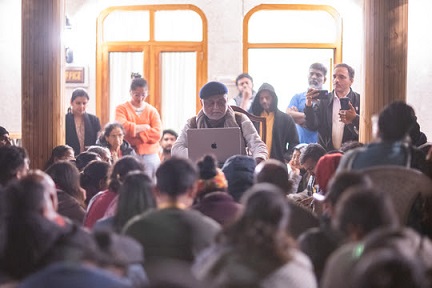
Daaji then mentioned that a song had been playing in his mind and said he would play it on his laptop. He then played the song Tu Meri Zindagi Hai (You are my life) by Noor Jehan from the film Mohabbat Mar Nahin Sakti. After this quiet and reflective moment, Daaji retired for the night.
Stay tuned for events from Daaji’s visit to Haldwani, Uttarakhand; Moradabad, Uttar Pradesh; and Gurugram, Haryana.
For more information regarding Daaji’s day-to-day life, visit www.daaji.org/glimpses